From the Forest Floor: How I Make Ceramic Jewelry from Foraged Elements
If you've been searching for handmade ceramic jewelry that actually comes from nature, not just pictures of it... you're in the right place. Every piece of botanical ceramic jewelry I make starts the same way. Not at a workbench. Not with a sketch. It starts on a trail.
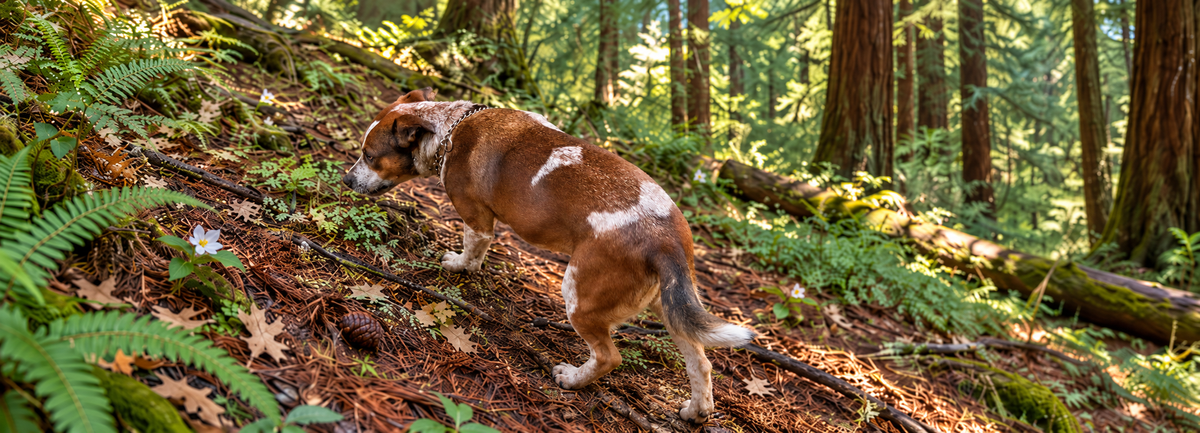
I'm Rae, and I make ceramic jewelry in the Santa Cruz Mountains, on ten acres of forest that I walk almost every day. My dog Red comes with me. Together we notice things. A curled madrone leaf. A stray wildflower that pushed up through the fallen leaves. A fern on the hillside catching the wind.
Those small things become ceramic leaf jewelry you can wear. Here's how.
Why Foraged Elements Make Better Ceramic Jewelry
Most jewelry starts with a design. Mine starts with a walk.
I don't sketch a leaf and try to recreate it in clay. I press the actual leaf into porcelain and stoneware clays. The veins, the torn edge, the place where a bug took a bite last August... all of it transfers into the surface. No two pieces come out the same, because no two leaves are the same.
That's the difference between nature inspired ceramic jewelry and jewelry that's just inspired by nature in theory. Mine has touched dirt. It's been rained on. It grew somewhere real before it became something you can wear.
In a world of mass production... this is the slow way. Slow art, made slowly, on purpose.
The Walk
Most days start early, before the fog burns off the ridge. Red runs ahead, nose down, tail up. I walk slower. I'm looking for texture, not scenery.
Some days I find nothing worth bringing into the studio. Other days my pockets fill up fast. A fern frond still uncurling. A scatter of wildflower petals. Leaves with a hole eaten clean through by something that got there before me. Once, a rock shaped almost exactly like a heart, sitting right in the middle of the trail like it wanted to be found.
I don't force it. The forest offers what it offers. My job is to notice.
From Forest Floor to Terracotta
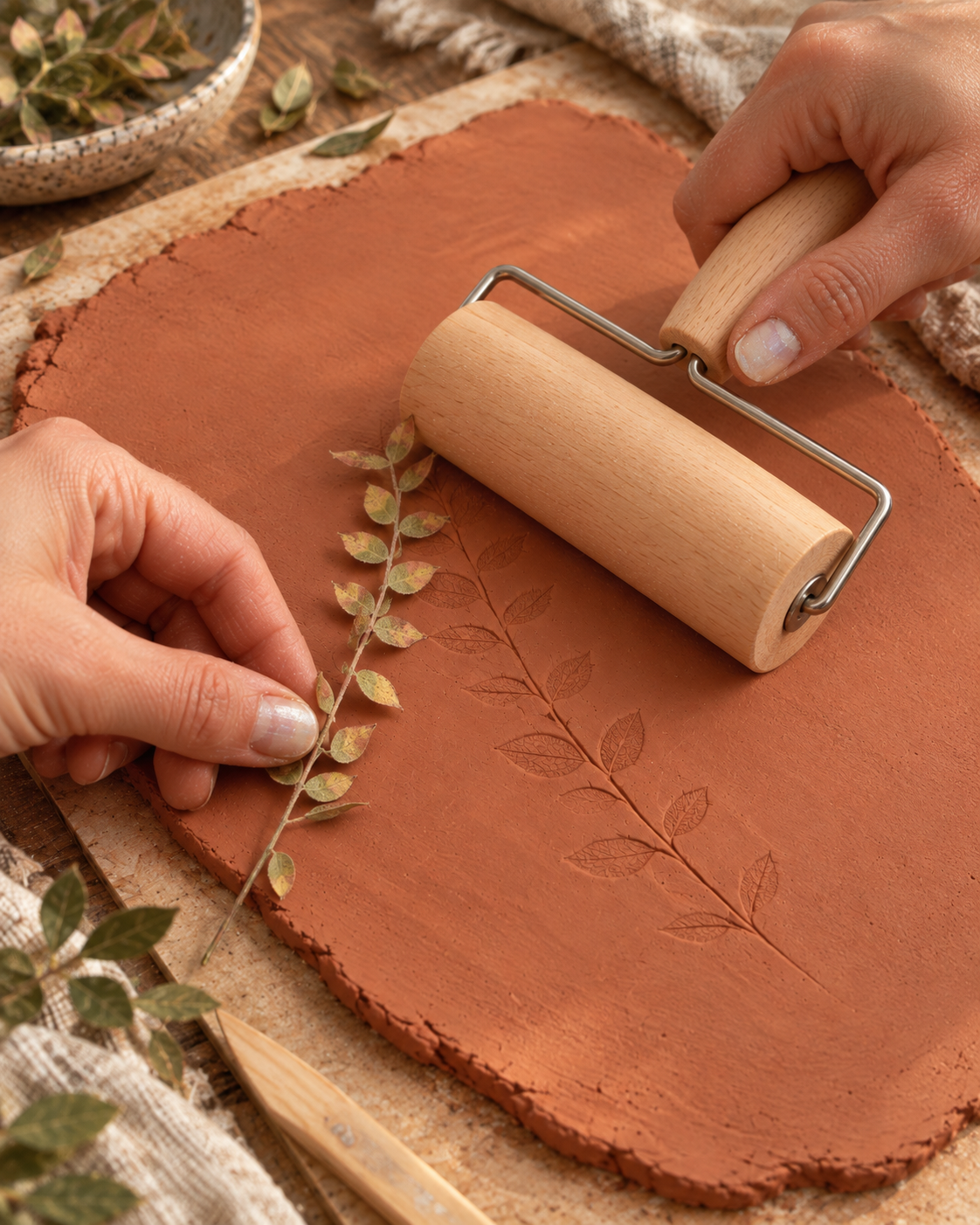
Back in the studio, the real work starts. Fresh leaves get pressed straight into soft clay while they still hold their shape, sometimes porcelain, sometimes a raw terracotta body like this one, depending on the color and texture I'm after. The pressure has to be even. Too light and the detail disappears in the firing. Too heavy and the leaf tears through.
Some pieces use metal clay instead, especially for ceramic leaf jewelry with more delicate botanicals. It fires down to solid silver, so a fern that existed for one season on this mountain ends up permanent, cool to the touch, ready to be worn for years.
This particular sprig became the Leaf Impression Pendant Necklace, finished in a deep sea blue glaze over the raw terracotta.
One Stamp, Two Stories
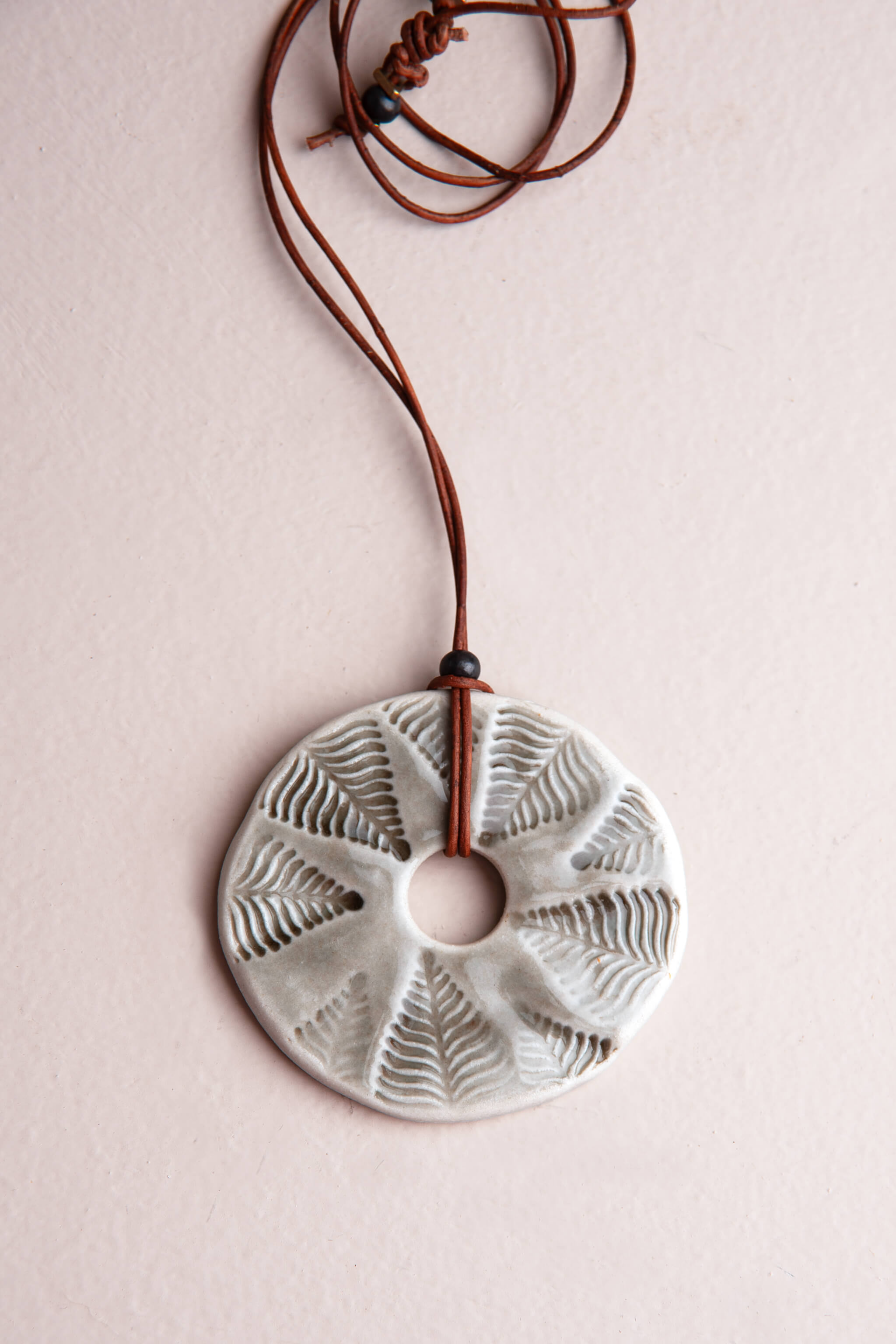
Not every mark comes from something I picked up on the trail. Some pieces are made with hand tools and stamps instead, the same fern stamp that presses a leaf pattern can turn into a sunburst depending on how I place it. No two pieces come out exactly alike, even from the same tool, so these stay one of a kind too. It's a different kind of impression. Not the forest pressing into the clay, but the forest living in the tools I reach for.
Every piece gets fired twice. Once to harden the clay, once to set the glaze. The forest leaves its fingerprint in that first firing. It never comes out again.
From Clay to Wearable Jewelry
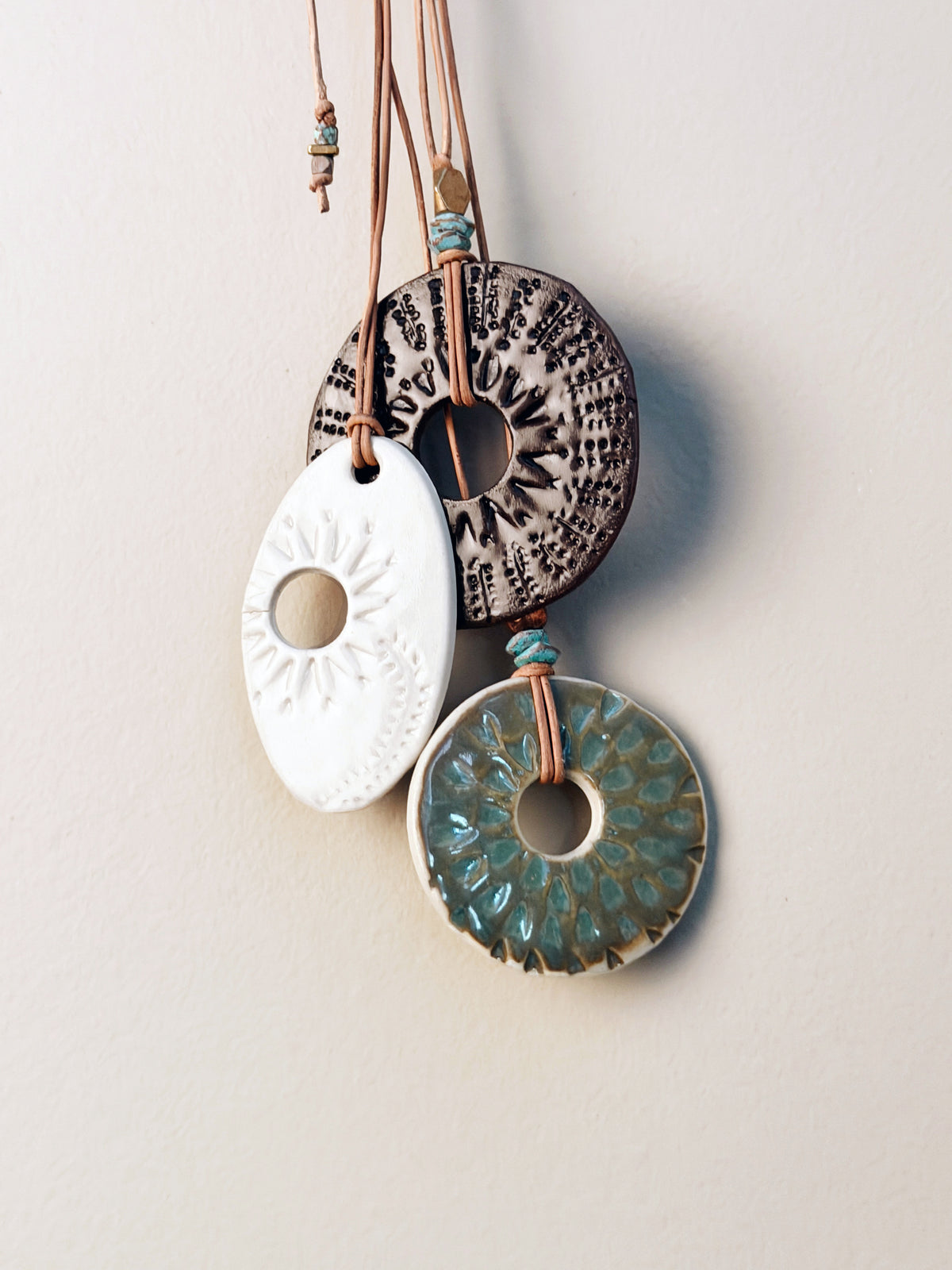
Once a piece is fired and glazed, it becomes something you can actually live with. Every pendant in my ceramic pendant necklaces collection starts as soft clay and a hand tool, natures elements, no stamps that press a whole design at once. I build each pattern one marking at a time: a sunburst radiating out from the center, a dense mandala ring, a field of short repeated lines. It's slow work, and it's why no two pendants ever come out identical, even when they share the same basic shape.
Every pendant hangs on soft Italian leather cord instead of chain. The cord is adjustable from a choker up to appx 26 inches, so one necklace can sit high and close one day and long and layered the next. Leather also ages the way the piece itself already has, quietly, with character instead of shine.
This is what handmade ceramic jewelry actually looks like up close: not a factory die stamping the same leaf onto a hundred identical pendants, but one artist, one mark at a time.
If you're drawn to jewelry that carries a story instead of just a shape, this is where that story lives... on a cord, resting close to the collarbone, shaped by hand one mark at a time until it became yours.
Beyond Jewelry: Ceramic Wall Art
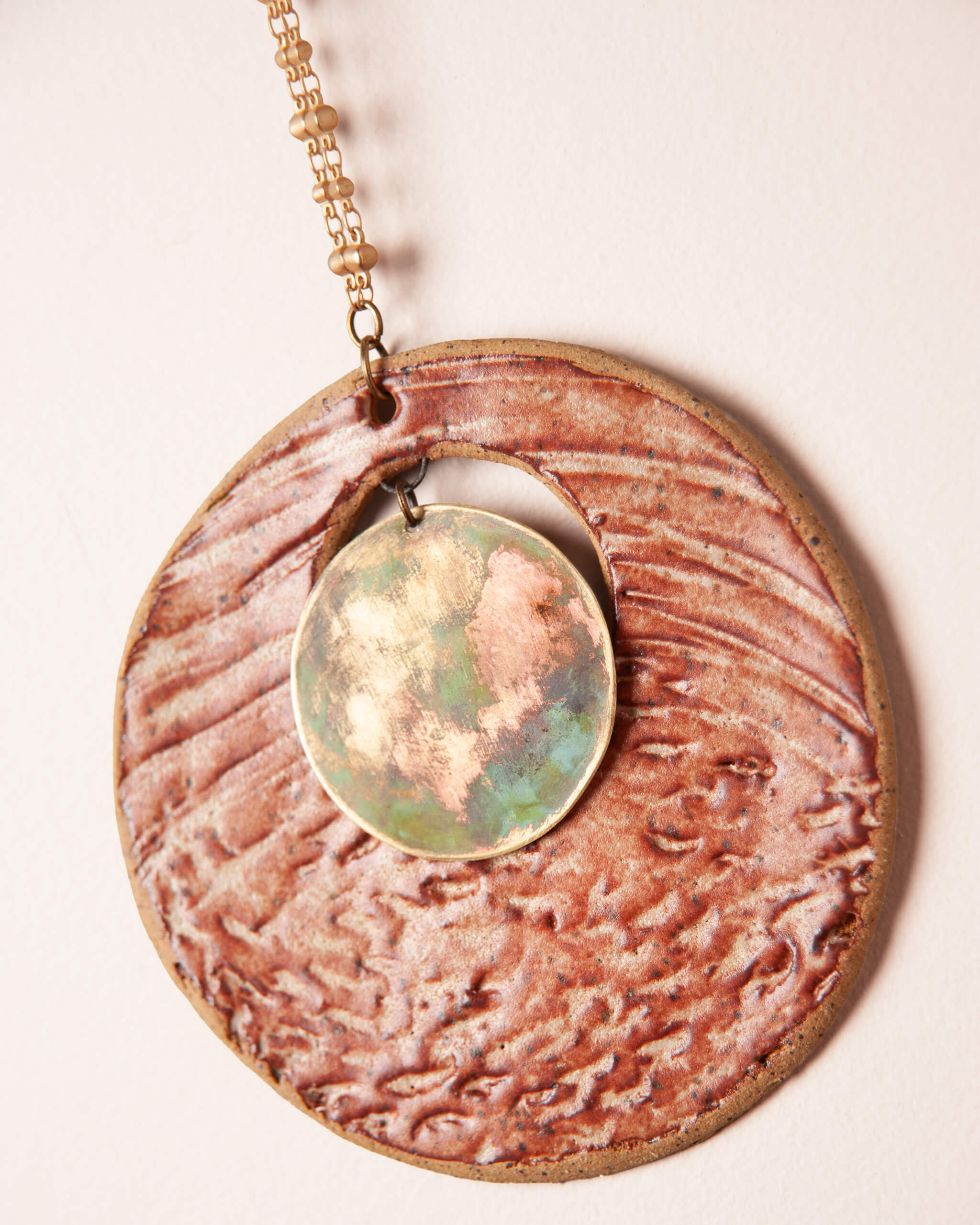
Some of the larger impressions don't become jewelry at all. They become handmade ceramic wall art, the kind of pieces people hang where they'll actually look at them every day. A fern impression the size of your palm holds its own on a wall the same way a small pendant holds its own around a neck.
What Makes This Different from Other Handmade Ceramic Jewelry
Which means the necklace you're looking at right now exists exactly once. Not limited edition. Actually one of one, the way all one of a kind ceramic art should be.
A lot of jewelry calls itself nature inspired. Most of it means a leaf shape stamped from a metal die, the same leaf, over and over, on every piece in the collection.
My foraged pieces can't do that. Once a real leaf goes into the clay and comes back out, it's spent. That specific leaf will never press another piece. Which means the necklace you're looking at right now exists exactly once. Not limited edition. Actually one of one.
That's the whole point of handmade ceramic jewelry made this way. It's not decoration copied from nature. It's a direct impression of a specific place, taken on a specific day, by someone who was actually standing in the forest when she found it.
Ceramic Jewelry from the Santa Cruz Mountains, Wherever You Wear It
I've lived on this land long enough to know its moods. The redwoods that hold fog in the canopy until noon. The madrones that shed their bark like they're molting. The wildflowers that show up for two weeks in spring and then disappear until next year.
Ceramic jewelry from the Santa Cruz Mountains carries that specificity. Not "nature" as an idea. This mountain. This soil. This particular fern, on this particular week, before the first rain of the season.
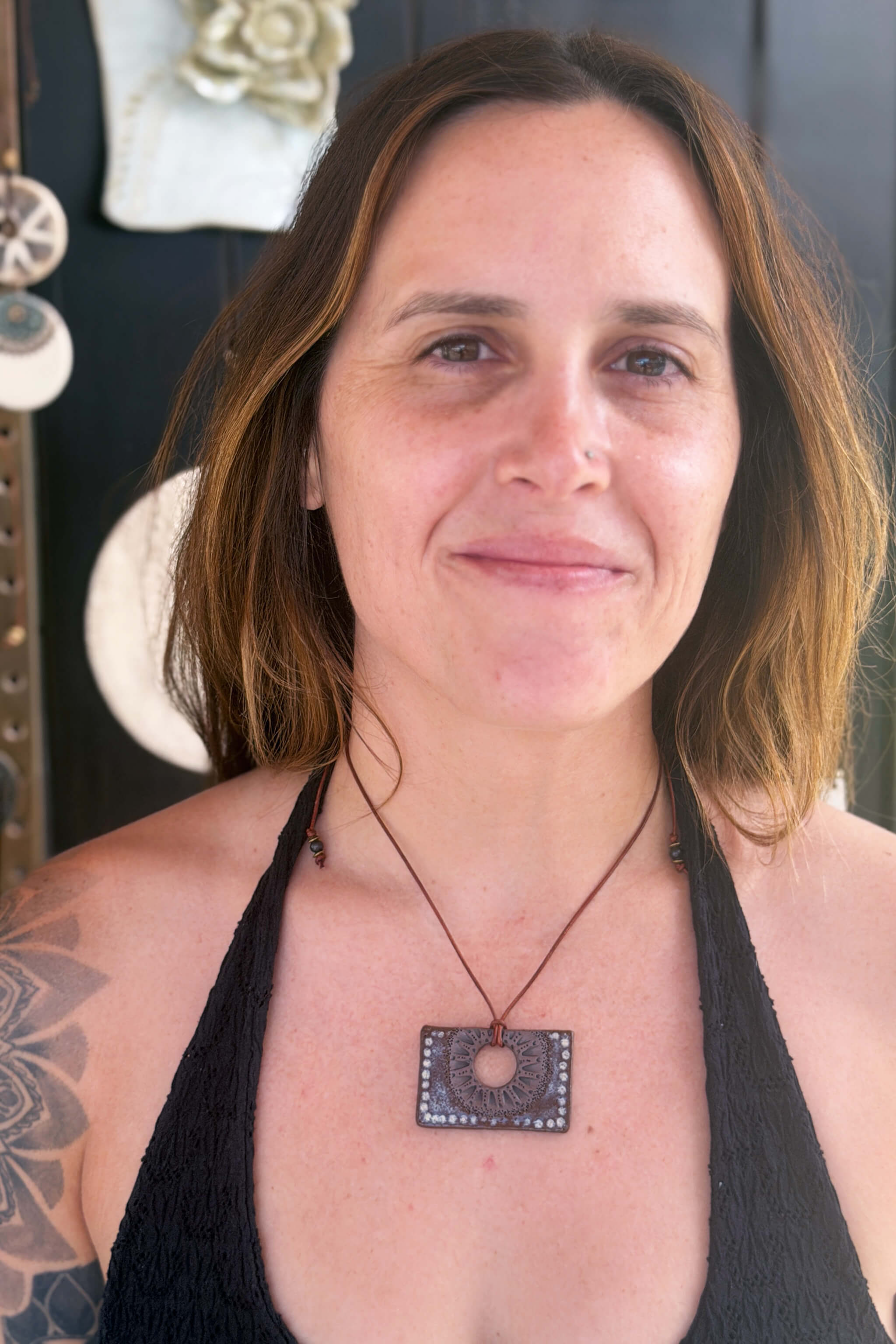
When you wear one of these pieces, you're not wearing a symbol of the outdoors. You're wearing a piece of ground I walked on with my dog, pressed into clay, fired twice, and strung on Italian leather so it could travel with you instead of staying behind on the trail.
Bringing the Forest Floor Home
Every piece begins with a walk. That's not a slogan I came up with for marketing. It's just true. Long before a necklace reaches a festival table or your front door, it was a leaf on the ground that Red sniffed past and I almost missed.
If that's the kind of jewelry you collect... pieces with a real story instead of a manufactured one... you'll find the current collection waiting for you, along with the wall pieces that came from the same walks.
Be the First to See What Comes From the Forest.
Collectors Circle insiders see new work before anyone else. That's always how it works around here.
Or browse the pendants while you wait.
Browse the pendants →
Rae Rodriguez is the artist and maker behind Jester Swink, a small batch ceramic art and jewelry studio based in the Santa Cruz Mountains of California. Every piece is made by hand with natural materials, intention, and a whole lotta love.